AI Security · June 21, 2026
High-security AI engineering starts with a data boundary
AI should make engineering faster. In high-security environments, it should not become a shortcut for leaking production, government, or user data into external systems.
Mirogate built secure-ai-engineering-framework around one rule: code and sanitized engineering context can use frontier models; sensitive data stays local or becomes synthetic mocks before crossing the boundary.
The model split
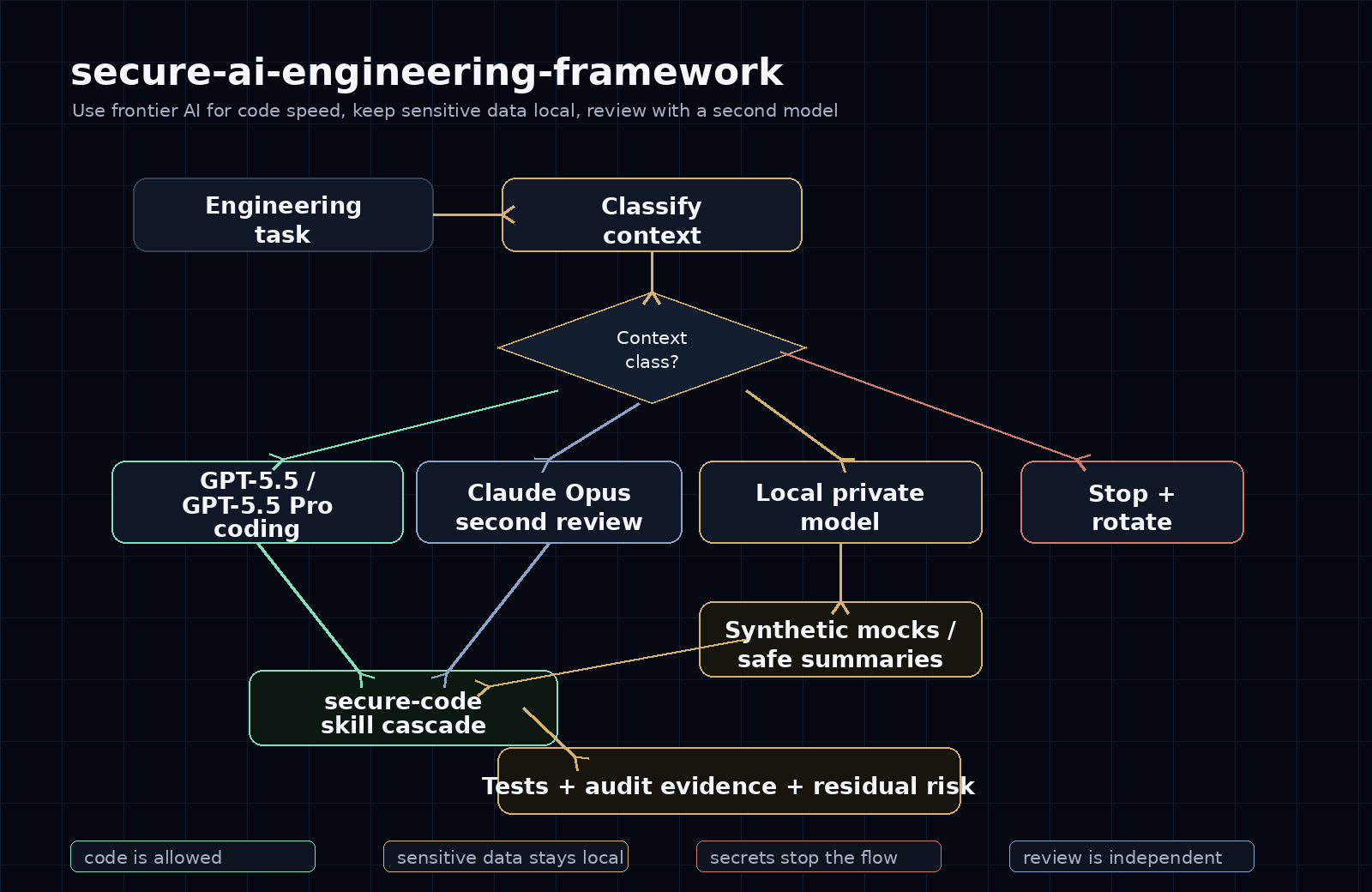
The framework separates model roles instead of treating one model as the whole process. GPT-5.5 is the primary coding path for external-safe engineering work. GPT-5.5 Pro is reserved for harder coding and security-sensitive reasoning. The latest Claude Opus policy entry acts as an independent second reviewer. A local model handles production rows, government records, user data, private logs, documents, and screenshots.
The boundary
The framework classifies context into four routes: public code, minimized private repo context, sensitive data, and secrets. Public code can go to frontier models. Private repo context needs minimization and classification. Sensitive data is local-only. Secrets stop the workflow and trigger rotation if exposed.
This keeps the engineering speed benefit while avoiding the dangerous habit of pasting production database rows, customer records, restricted documents, or logs into a coding assistant. When real data is needed to debug, the local path extracts schema, constraints, failure shape, and synthetic examples. GPT-5.5 or Claude Opus can then reason over safe mocks instead of real records.
The security layer
Generated code still needs security review. The framework references Mirogate's secure-code-skill-cascade so AI-generated patches can be checked against auth, input, data, dependency, cloud, and AI-agent security modules before deployment.
What we released
The first release includes a Codex skill, eleven focused modules, a model routing policy, prompt classification, synthetic mock generation, private context-pack tooling, six workflow scenarios, six boundary demos, validation scripts, and tests.
npm test
node scripts/classify.mjs --text "export function add(a,b){return a+b}"
node scripts/mock-from-schema.mjs --schema examples/schema/customer-case.schema.json
node scripts/compose.mjs --scenario production-db-debug
The source is available at github.com/mirogate/secure-ai-engineering-framework.
This is not a compliance certification or legal opinion. It is a practical framework for keeping AI-assisted engineering fast while enforcing a clear data boundary.